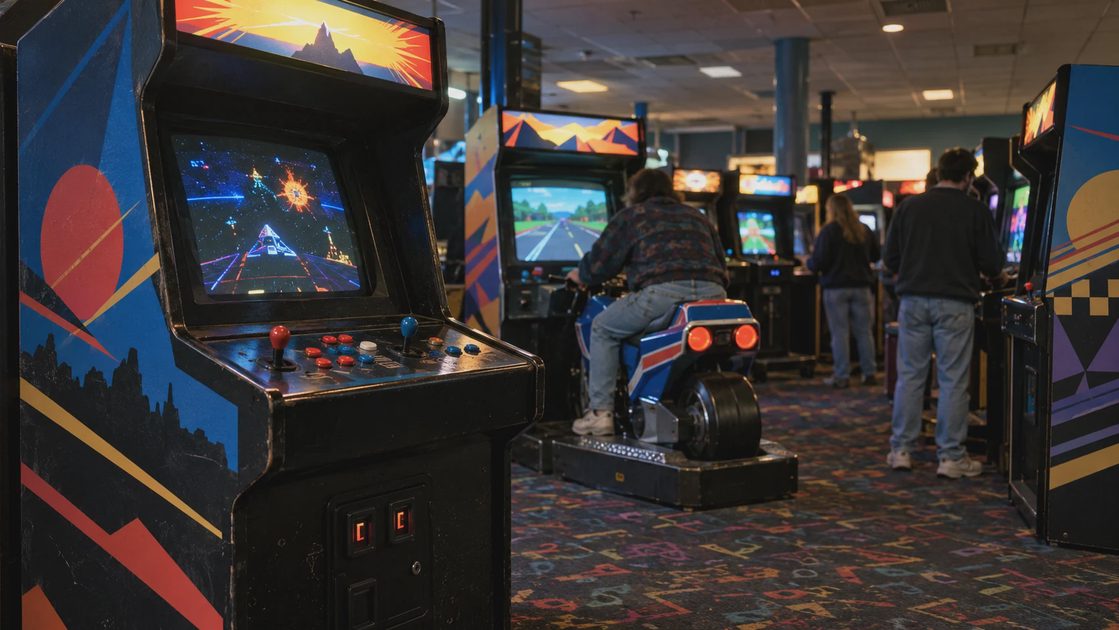
Arcade games often felt bigger because the game, controls, cabinet, and audience arrived as one experience. In the late 1980s and early 1990s, technical differences could add to that impression, but graphics alone don't explain it. When I consider arcade vs console memories, I separate what the software could do from what the room made it feel like.
That distinction matters when you replay something today. A faithful version can preserve the action and still feel surprisingly modest on a television. The missing ingredient may be the setting rather than a failure of the game—or your memory.
The machine could make its own first impression
A home console had to serve many games through the same basic arrangement: a television, a controller, and whatever space the household could spare. An arcade cabinet could give a particular game its own physical invitation.
Sega's Hang-On makes the distinction concrete. Its ride-on motorcycle cabinet let players straddle the machine and steer by shifting their weight. Sega's history of its body-controlled arcade games describes that interface and the later run of machines including Space Harrier, Out Run, and After Burner.
I find that more revealing than a screenshot comparison. Bringing a racing game home could preserve its roads, opponents, and basic goal while changing the action your body performed. Pressing a directional pad and leaning a motorcycle-shaped cabinet are different experiences even before either screen draws the next corner.
Not every arcade had a spectacular moving machine. Plenty of memorable games lived in ordinary upright cabinets. But even an upright gave the game a dedicated surface, an established control position, and a place to stand. The machine framed the encounter before you learned its rules.
That is part of why the arcade cabinet experience can resist being reduced to a bigger display. The cabinet also determines where your hands go, how close you stand, and how you share the space with someone else.
Arcade hardware had advantages, with important exceptions
There was also a real technical reason to notice differences between arcade graphics and console graphics. Arcade hardware and home consoles faced different commercial constraints. An operator could earn money from repeated plays on a machine; a household bought a system expected to support years of different games.
Those conditions could make room for arcade designs that were impractical in an affordable home package. The visible result might be larger characters, more elaborate animation, or effects that a contemporary conversion had to simplify. I would still name the particular game and version before making that judgment. “Arcade hardware” covers many different boards, generations, and ambitions.
The Neo Geo is the useful complication. SNK offered the arcade MVS and home AES with matching specifications and software titles, as its official Neo Geo retrospective explains. That brought arcade capability into the home at a premium price; it did not somehow turn the living room into the arcade.
The same retrospective highlights the zoom effects in the Art of Fighting series and the intricate pixel detail of Metal Slug. Those are helpful examples of what technical ambition could look like: characters and scenes with a stronger sense of presence. “Bigger” could mean richer movement and expression, rather than a longer adventure or a larger map.
I wouldn't use that exception to dismiss the gap other players saw. It helps define the gap: access to particular hardware at a price, in a particular year. It was never a permanent law that a game became technically superior when someone attached a coin slot.
For arcade game history, that is a more useful starting point than treating “arcade” and “console” as two fixed levels of power. Compare specific releases and the compromises become easier to understand.
A port could keep the characters and change the occasion
Arcade ports were often the first way to spend more time with a game you could previously play only on visits. That access mattered. The home version did not need to win every comparison to become someone's favorite.
But the name on the box could hide meaningful differences. Consider the original SNES release of Final Fight: its character choices are Cody and Haggar, rather than the arcade game's three-person roster including Guy. Capcom's original SNES manual documents those home-version characters. This example concerns that release, not every later version bearing the title.
I care about an omission like that because a favorite character is part of how someone enters a game. A version can look recognizably correct while removing the choice that made you want to play it.
The same principle applies more broadly to multiplayer, controls, and the pace of an encounter. A hypothetical conversion that loses simultaneous cooperative play changes the evening you can have with a friend. That difference matters more than a small discrepancy in a background decoration.
When evaluating the promise of arcade-perfect ports, I would check three things before counting visual details:
The activity: Are the modes, character choices, and player arrangements you want actually present?
The handling: Does the available controller support the actions the game expects comfortably?
The presentation: Are important animation, sound cues, and on-screen information preserved clearly?
That isn't a demand for flawless imitation. It identifies whether the conversion carries the parts of the game you came back for. A thoughtful adaptation can be enjoyable on its own terms, even when it takes another route.
The room made a match public
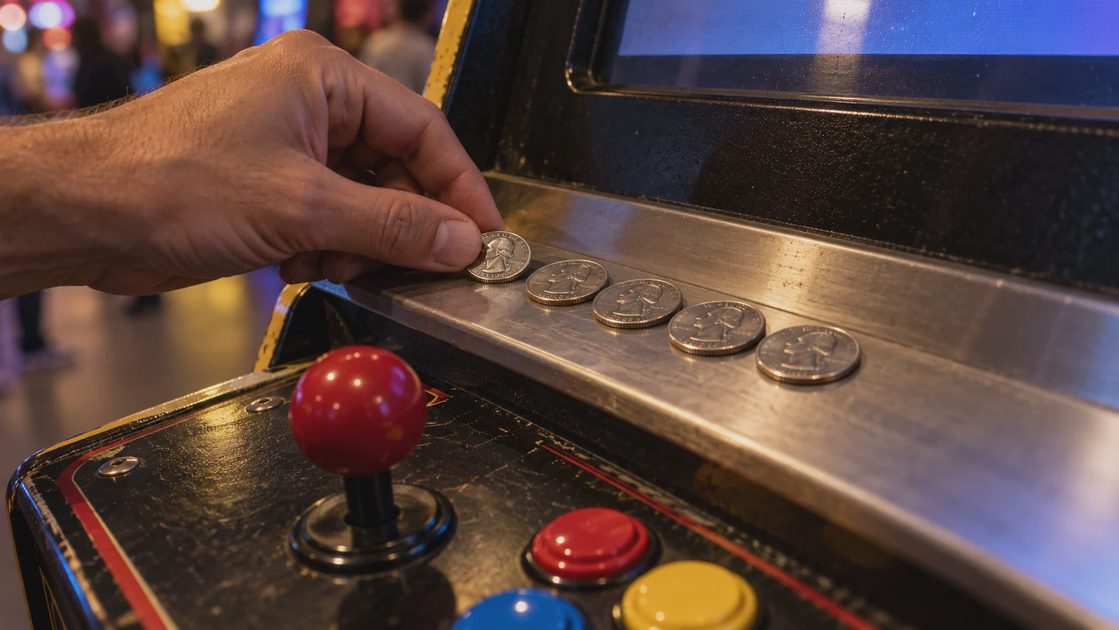
My clearest example comes from the winter of 1993 at Aladdin's Castle in Louisville's Jefferson Mall. Around Street Fighter II, quarters lined the edge of the cabinet to mark who wanted the next challenge. Putting a coin down meant placing yourself in that little public sequence.
The attraction wasn't simply watching fighters move. Another person stood beside you, and other players could see the result. At nine, that gave the match a weight that was difficult to separate from the game itself.
I don't take that memory as evidence that public competition was automatically better. Being watched can make a game exciting, but it can also make learning uncomfortable. A quiet practice session at home has real value, especially when you want to understand a move without performing your mistakes for strangers.
Still, it explains some of the scale in my recollection. The game occupied more than the screen: it organized waiting, watching, playing, and making room for the next person. My memory contains those surrounding actions along with the match.
When I revisit 90s arcade games alone, I would expect some of that social energy to be absent. I wouldn't ask a graphics setting to restore it. Inviting someone to play or watch would address a different part of the memory than adjusting pixels.
Paying for attempts sharpened the edges
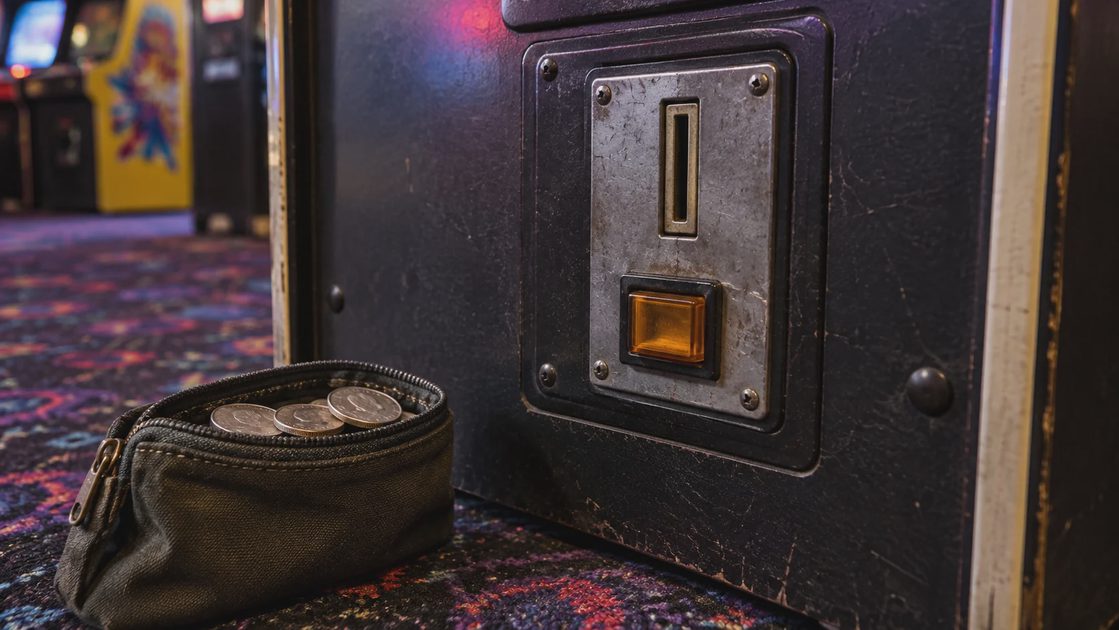
A credit also gave an attempt a visible boundary. Losing could mean another payment, another decision about continuing, or the end of your turn. That made the opening moments and the next mistake feel consequential.
I can respect the concentration that structure encouraged without recommending every punishment it produced. Repeated payments don't establish that a difficulty spike was fair. Nor does unlimited access at home automatically make a game shallow.
The practical difference is what failure costs you now. If I were replaying a coin-operated game through a modern release with generous continues, I would watch whether I was learning encounters or merely pushing through them. If continuing became automatic, I might give myself a modest attempt limit so each run had a purpose.
That would be an optional way to shape the session. I wouldn't treat it as a test of whether someone deserves to enjoy the game.
Cabinet sound added another layer to the encounter: a voice cue, impact, or musical phrase could draw attention from the room around it. I would separate that attention-grabbing presentation from the underlying quality of the soundtrack. Loudness can make something noticeable; it cannot make every sound choice good.
What I would bring into a replay
The useful lesson is to identify which part of the larger experience you actually miss. It might be a particular arcade version, a control layout, competition beside another person, or the focus of a short run.
I wouldn't start by buying a cabinet. I would choose one remembered game and name one feature that made it matter: a character, a shared mode, a physical action, or an audience. Then I would select a replay arrangement that preserves that feature. That gives the memory a specific request the present can answer.